Michael Estiban Smith
UX & Design Director

Johnny's Deli Kiosk
Fixing the order experience for a premium convenience sub-brand


Johnny's Deli had a product problem that was actually an experience problem.
The food was good. The concept was strong — premium hot deli sandwiches, fast, inside a 7-Eleven. But the ordering experience was broken from the moment a customer walked in. A barcode to scan in the app that didn't always work. An ordering counter that turned out to be the pickup area. Staff pulled in two directions at once. Customers confused, frustrated, and walking away.
The brief was to design a self-service kiosk that would fix the ordering flow — and as a secondary benefit, allow customers to add other 7-Eleven store items to their order in the same transaction.
Platform
Self-service kiosk
Role
Lead UX Designer
Duration
Discovery through to approved design
Outcome
Fully designed and approved kiosk concept; research and UX thinking directly informed 7-Eleven's subsequent generic kiosk rollout
The Challenge
Johnny's Deli had launched with an app-based ordering flow — customers scanned a barcode in-store to place their order.
In practice it was unreliable, and when it failed customers did what felt natural: they walked to the counter. The problem was that counter was the pickup area, not the ordering point. Customers would wait there expecting to order, staff would attend to them across the counter, and the regular 7-Eleven queue behind them would back up as a result.
The sub-brand was premium. The food was good. But every part of the ordering experience was working against that positioning — creating confusion for customers and operational friction for staff. A self-service kiosk was proposed as the solution: a dedicated ordering point that would remove the ambiguity, take pressure off staff, and give Johnny's Deli the experience its product deserved.
Discover
I conducted stakeholder interviews to understand business and operational constraints, then moved into stores to observe real customer behaviour — watching where confusion occurred and how staff were compensating. User interviews surfaced the mental models customers brought with them: what they expected when they walked in, where they looked first, and why the current experience felt harder than it should.
Define
The research made the core problem clear: customers had no reliable, independent path to place an order, and the physical layout gave no signal about where to start. The kiosk needed to make the ordering path unambiguous from the moment a customer approached. The secondary opportunity — adding store items to a food order — was validated in research as genuinely useful and shaped the broader interaction model.
Design
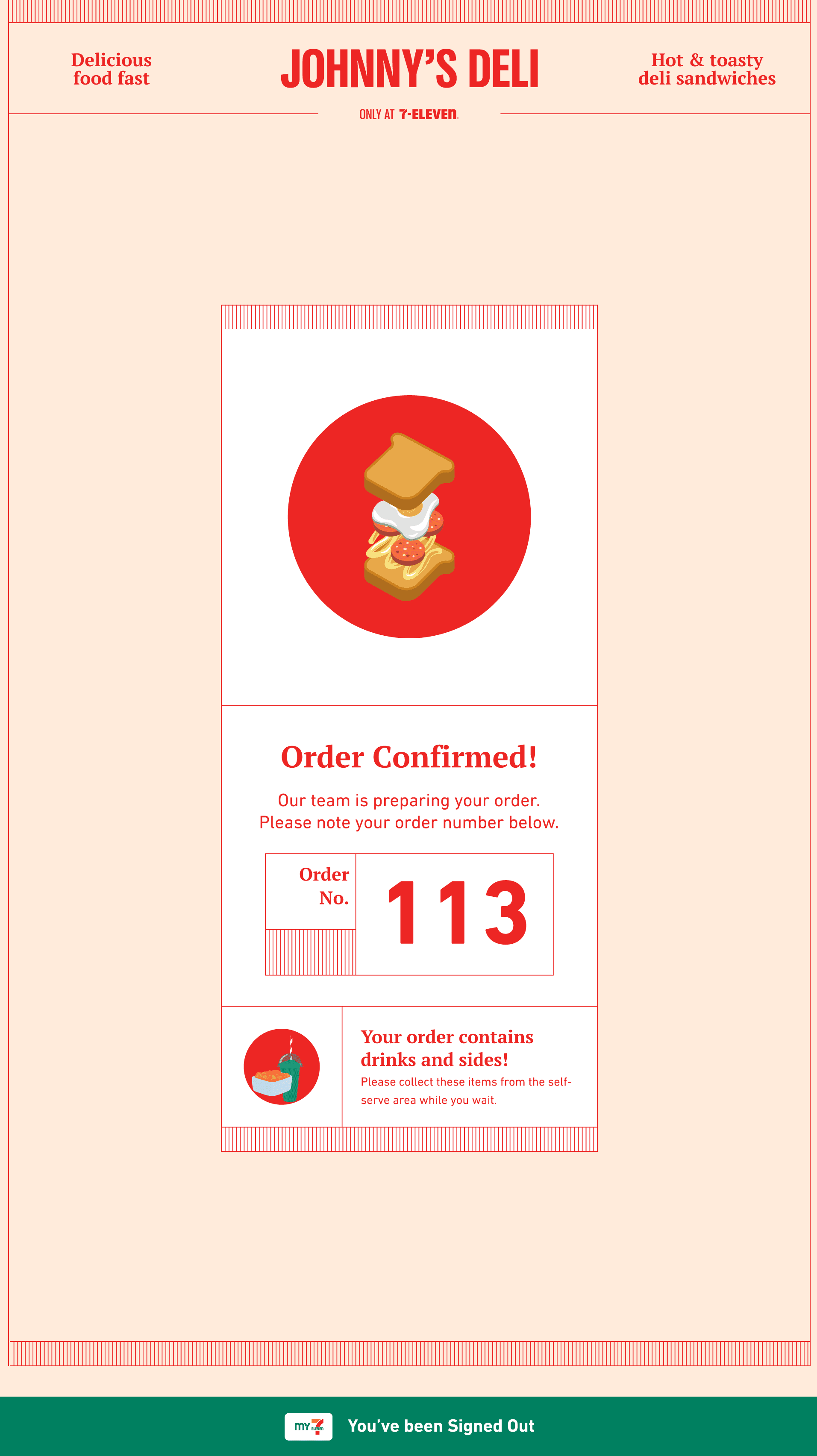
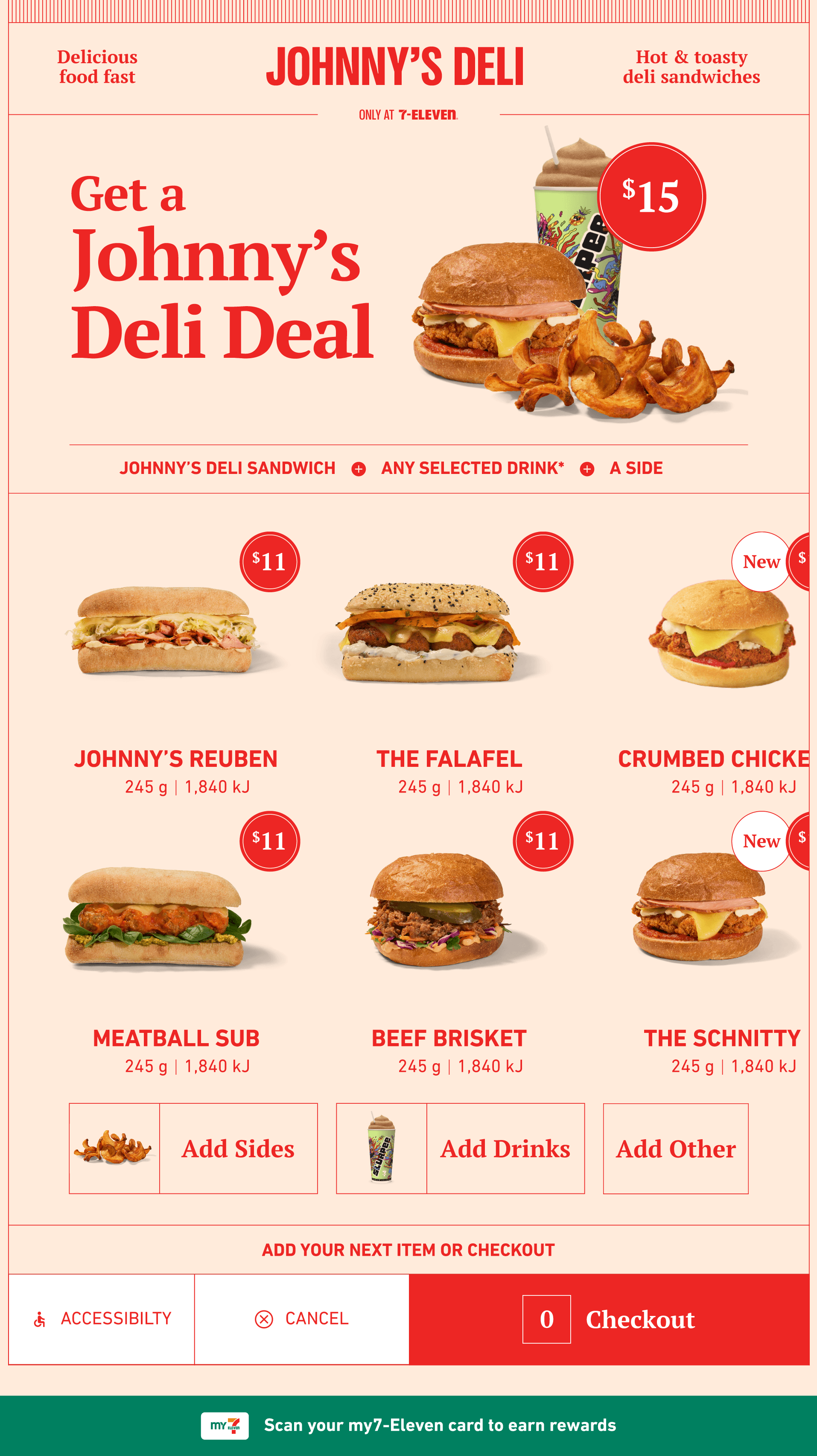
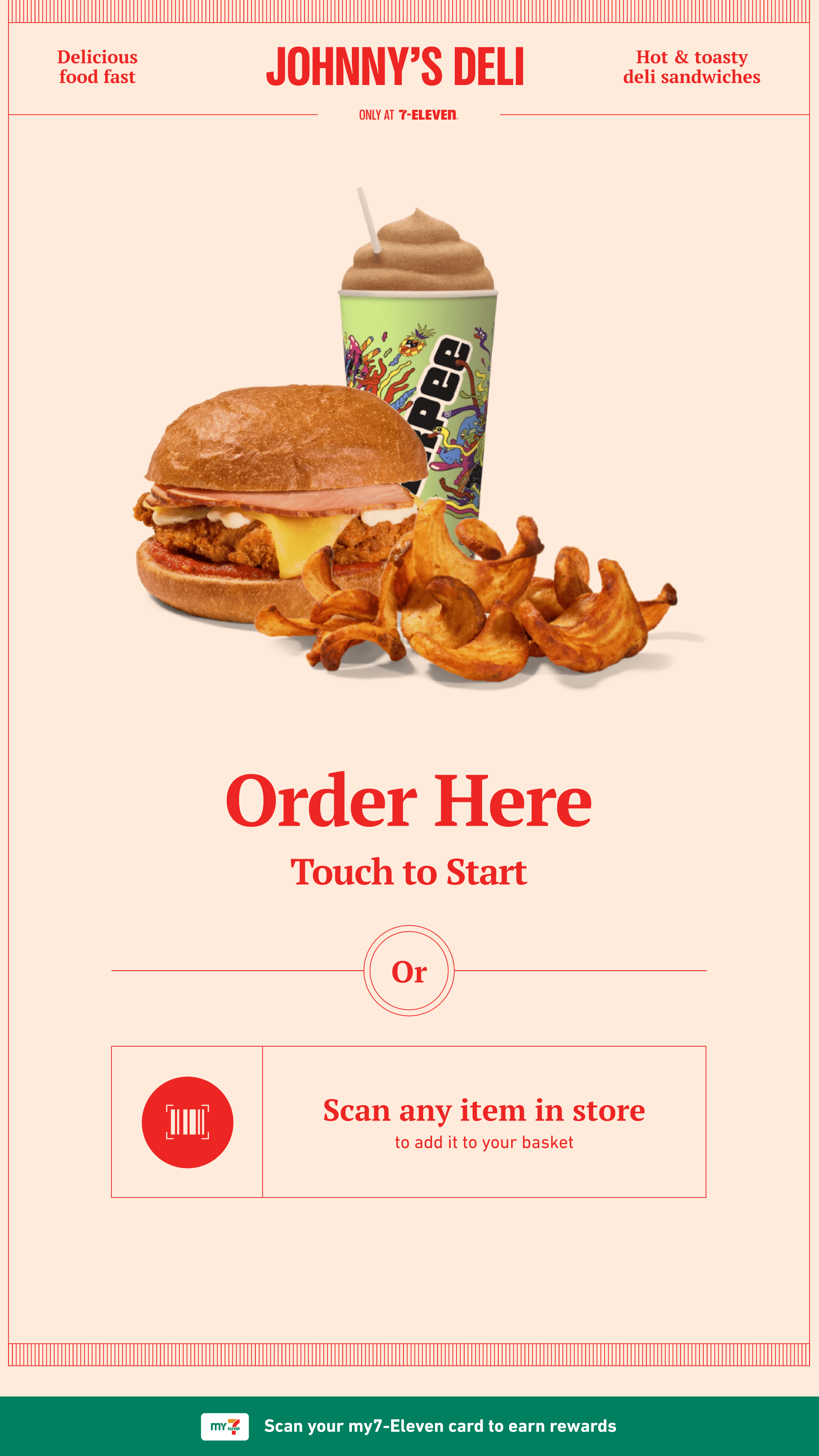
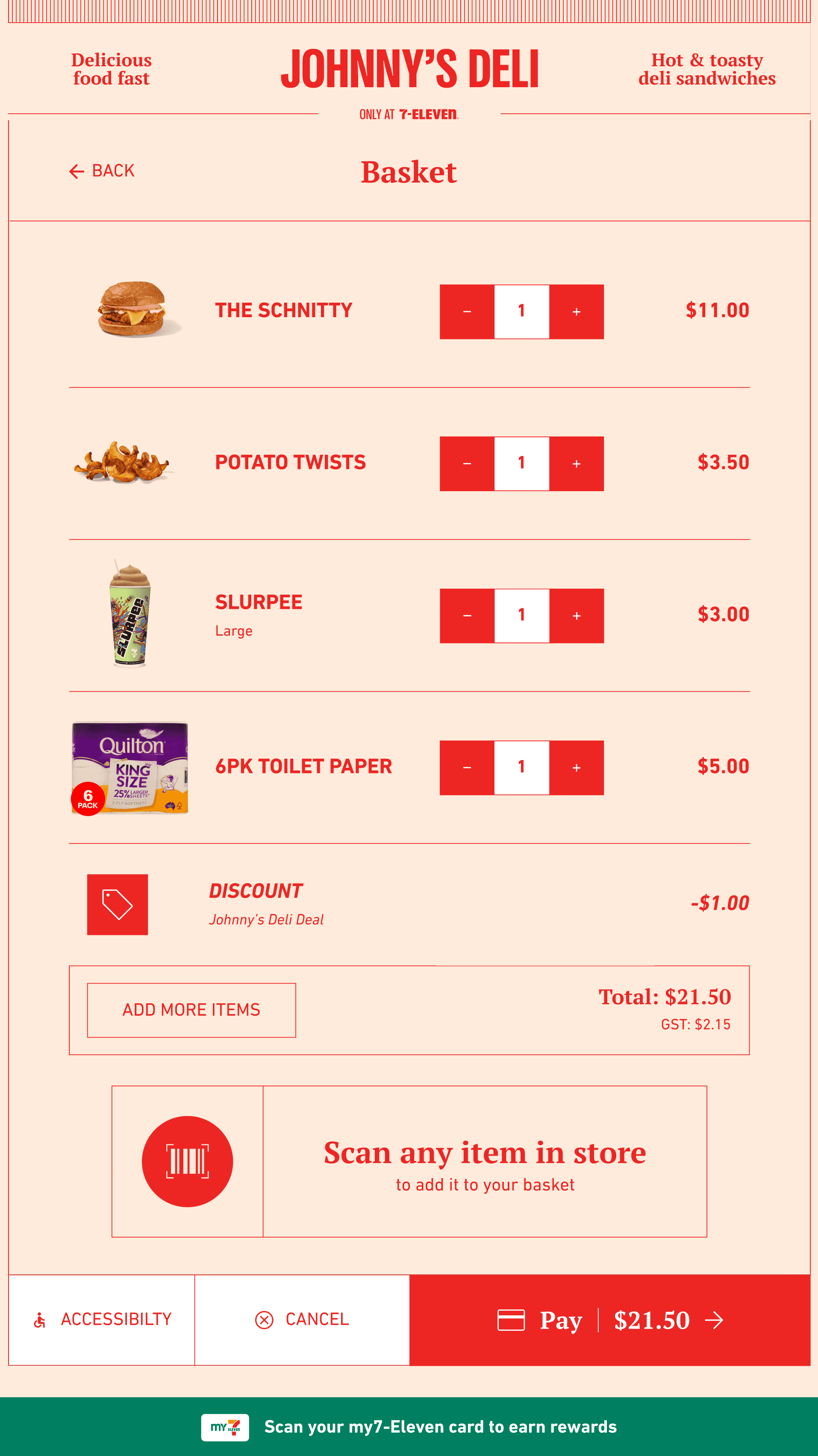
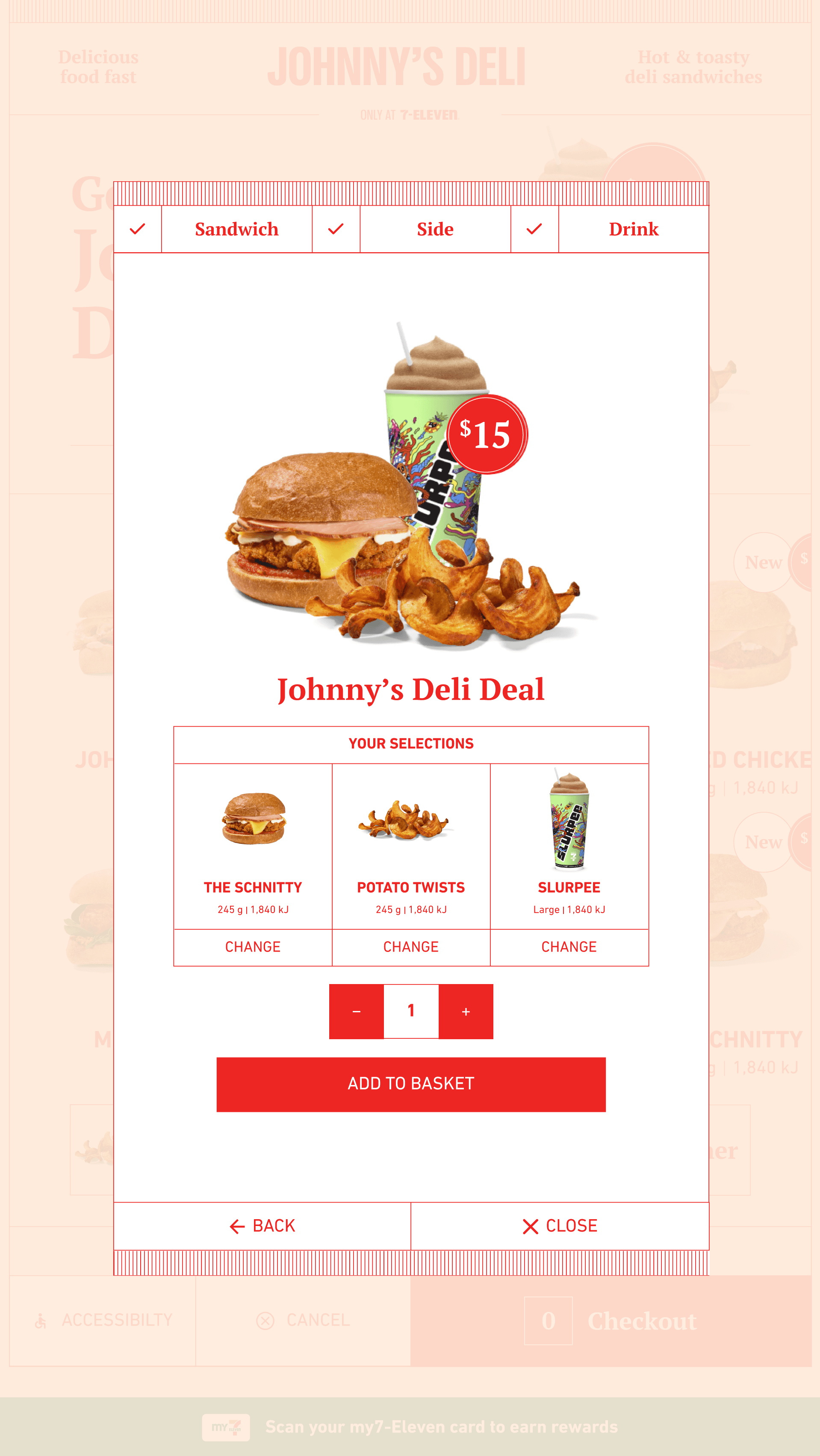
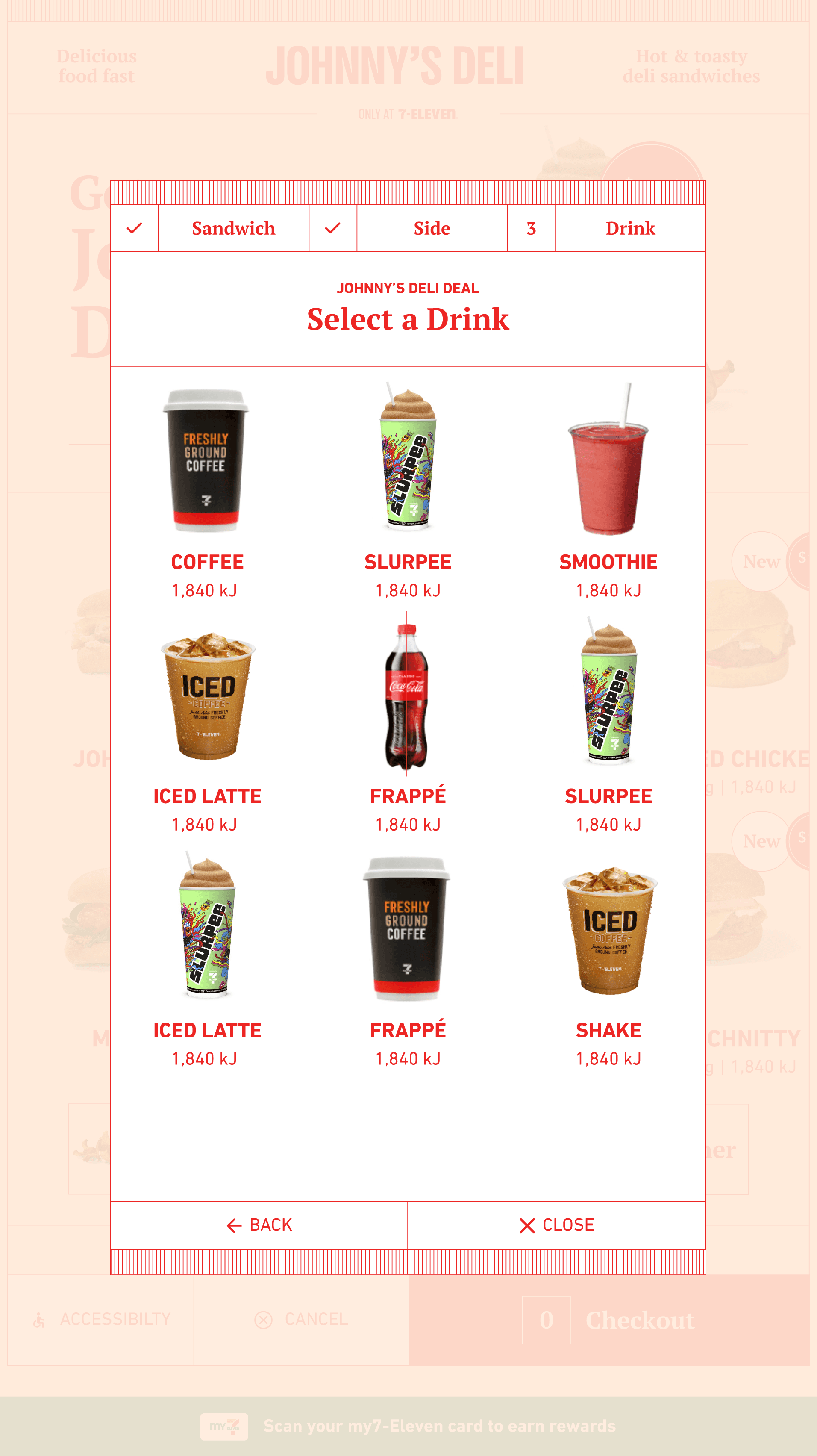
I designed the full kiosk interface from attract screen to order confirmation — prioritising immediate clarity, with no reliance on the app or staff. The menu showcased the Johnny's Deli range in a food-forward, visually rich layout. The add-on flow let customers include store items in the same transaction, reducing friction and increasing basket size. The final design was approved and ready for production before the Johnny's Deli business was wound down.


Outcome
The Johnny's Deli kiosk didn't launch — the sub-brand was spun down before it reached stores. But the work didn't disappear with it.
The UX research and interaction model — particularly the insight around how customers would add non-deli store items to a food order — became a stepping-off point for 7-Eleven's subsequent generic kiosk experience, which has since launched across stores.
The best design work sometimes travels further than the brief it was written for.
What I learned
A broken experience isn't always a design problem waiting for a design solution. Sometimes the fix is removing a step entirely — replacing an inconsistent app flow and an ambiguous physical layout with a single, clear point of interaction. This project reinforced how much context matters in kiosk and in-store UX: the environment, the customer's mental model walking in, and the operational reality for staff are all part of the design problem. Ignore any one of them and the solution won't hold.

About
I'm a UX and design leader with 19 years of hands-on experience — from discovery and research through to interaction design, UI direction, and design systems. I lead from within the work, not above it.
I've spent the last eight years at Balance and Digitas Australia building and leading UX and design capability — growing practice, embedding research, and delivering across some of Australia's most recognised brands. That work contributed to Balance being awarded Campaign Agency of the Year in eCommerce in 2024, and Digitas Australia taking out the same award the following year.
Let's talk
If you're building a design-led digital practice and need someone who'll get into the work, raise the quality, and help shape where the agency goes next — I'd love to talk.
Get in Touch
Find me on LinkedIn
Back
Michael Estiban Smith
UX & Design Director

Johnny's Deli Kiosk
Fixing the order experience for a premium convenience sub-brand


Johnny's Deli had a product problem that was actually an experience problem.
The food was good. The concept was strong — premium hot deli sandwiches, fast, inside a 7-Eleven. But the ordering experience was broken from the moment a customer walked in. A barcode to scan in the app that didn't always work. An ordering counter that turned out to be the pickup area. Staff pulled in two directions at once. Customers confused, frustrated, and walking away.
The brief was to design a self-service kiosk that would fix the ordering flow — and as a secondary benefit, allow customers to add other 7-Eleven store items to their order in the same transaction.
Platform
Self-service kiosk
Role
Lead UX Designer
Duration
Discovery through to approved design
Outcome
Fully designed and approved kiosk concept; research and UX thinking directly informed 7-Eleven's subsequent generic kiosk rollout
The Challenge
Johnny's Deli had launched with an app-based ordering flow — customers scanned a barcode in-store to place their order.
In practice it was unreliable, and when it failed customers did what felt natural: they walked to the counter. The problem was that counter was the pickup area, not the ordering point. Customers would wait there expecting to order, staff would attend to them across the counter, and the regular 7-Eleven queue behind them would back up as a result.
The sub-brand was premium. The food was good. But every part of the ordering experience was working against that positioning — creating confusion for customers and operational friction for staff. A self-service kiosk was proposed as the solution: a dedicated ordering point that would remove the ambiguity, take pressure off staff, and give Johnny's Deli the experience its product deserved.
Discover
I conducted stakeholder interviews to understand business and operational constraints, then moved into stores to observe real customer behaviour — watching where confusion occurred and how staff were compensating. User interviews surfaced the mental models customers brought with them: what they expected when they walked in, where they looked first, and why the current experience felt harder than it should.
Define
The research made the core problem clear: customers had no reliable, independent path to place an order, and the physical layout gave no signal about where to start. The kiosk needed to make the ordering path unambiguous from the moment a customer approached. The secondary opportunity — adding store items to a food order — was validated in research as genuinely useful and shaped the broader interaction model.
Design
I designed the full kiosk interface from attract screen to order confirmation — prioritising immediate clarity, with no reliance on the app or staff. The menu showcased the Johnny's Deli range in a food-forward, visually rich layout. The add-on flow let customers include store items in the same transaction, reducing friction and increasing basket size. The final design was approved and ready for production before the Johnny's Deli business was wound down.


Outcome
The Johnny's Deli kiosk didn't launch — the sub-brand was spun down before it reached stores. But the work didn't disappear with it.
The UX research and interaction model — particularly the insight around how customers would add non-deli store items to a food order — became a stepping-off point for 7-Eleven's subsequent generic kiosk experience, which has since launched across stores.
The best design work sometimes travels further than the brief it was written for.
What I learned
A broken experience isn't always a design problem waiting for a design solution. Sometimes the fix is removing a step entirely — replacing an inconsistent app flow and an ambiguous physical layout with a single, clear point of interaction. This project reinforced how much context matters in kiosk and in-store UX: the environment, the customer's mental model walking in, and the operational reality for staff are all part of the design problem. Ignore any one of them and the solution won't hold.

About
I'm a UX and design leader with 19 years of hands-on experience — from discovery and research through to interaction design, UI direction, and design systems. I lead from within the work, not above it.
I've spent the last eight years at Balance and Digitas Australia building and leading UX and design capability — growing practice, embedding research, and delivering across some of Australia's most recognised brands. That work contributed to Balance being awarded Campaign Agency of the Year in eCommerce in 2024, and Digitas Australia taking out the same award the following year.
Let's talk
If you're building a design-led digital practice and need someone who'll get into the work, raise the quality, and help shape where the agency goes next — I'd love to talk.
Get in Touch
Find me on LinkedIn
Johnny's Deli Kiosk
Fixing the order experience for a premium convenience sub-brand


Johnny's Deli had a product problem that was actually an experience problem.
The food was good. The concept was strong — premium hot deli sandwiches, fast, inside a 7-Eleven. But the ordering experience was broken from the moment a customer walked in. A barcode to scan in the app that didn't always work. An ordering counter that turned out to be the pickup area. Staff pulled in two directions at once. Customers confused, frustrated, and walking away.
The brief was to design a self-service kiosk that would fix the ordering flow — and as a secondary benefit, allow customers to add other 7-Eleven store items to their order in the same transaction.
Platform
Self-service kiosk
Role
Lead UX Designer
Duration
Discovery through to approved design
Outcome
Fully designed and approved kiosk concept; research and UX thinking directly informed 7-Eleven's subsequent generic kiosk rollout
The Challenge
Johnny's Deli had launched with an app-based ordering flow — customers scanned a barcode in-store to place their order.
In practice it was unreliable, and when it failed customers did what felt natural: they walked to the counter. The problem was that counter was the pickup area, not the ordering point. Customers would wait there expecting to order, staff would attend to them across the counter, and the regular 7-Eleven queue behind them would back up as a result.
The sub-brand was premium. The food was good. But every part of the ordering experience was working against that positioning — creating confusion for customers and operational friction for staff. A self-service kiosk was proposed as the solution: a dedicated ordering point that would remove the ambiguity, take pressure off staff, and give Johnny's Deli the experience its product deserved.
Discover
I conducted stakeholder interviews to understand business and operational constraints, then moved into stores to observe real customer behaviour — watching where confusion occurred and how staff were compensating. User interviews surfaced the mental models customers brought with them: what they expected when they walked in, where they looked first, and why the current experience felt harder than it should.
Define
The research made the core problem clear: customers had no reliable, independent path to place an order, and the physical layout gave no signal about where to start. The kiosk needed to make the ordering path unambiguous from the moment a customer approached. The secondary opportunity — adding store items to a food order — was validated in research as genuinely useful and shaped the broader interaction model.
Design
I designed the full kiosk interface from attract screen to order confirmation — prioritising immediate clarity, with no reliance on the app or staff. The menu showcased the Johnny's Deli range in a food-forward, visually rich layout. The add-on flow let customers include store items in the same transaction, reducing friction and increasing basket size. The final design was approved and ready for production before the Johnny's Deli business was wound down.


Outcome
The Johnny's Deli kiosk didn't launch — the sub-brand was spun down before it reached stores. But the work didn't disappear with it.
The UX research and interaction model — particularly the insight around how customers would add non-deli store items to a food order — became a stepping-off point for 7-Eleven's subsequent generic kiosk experience, which has since launched across stores.
The best design work sometimes travels further than the brief it was written for.
What I learned
A broken experience isn't always a design problem waiting for a design solution. Sometimes the fix is removing a step entirely — replacing an inconsistent app flow and an ambiguous physical layout with a single, clear point of interaction. This project reinforced how much context matters in kiosk and in-store UX: the environment, the customer's mental model walking in, and the operational reality for staff are all part of the design problem. Ignore any one of them and the solution won't hold.

About
I'm a UX and design leader with 19 years of hands-on experience — from discovery and research through to interaction design, UI direction, and design systems. I lead from within the work, not above it.
I've spent the last eight years at Balance and Digitas Australia building and leading UX and design capability — growing practice, embedding research, and delivering across some of Australia's most recognised brands. That work contributed to Balance being awarded Campaign Agency of the Year in eCommerce in 2024, and Digitas Australia taking out the same award the following year.
Let's talk
If you're building a design-led digital practice and need someone who'll get into the work, raise the quality, and help shape where the agency goes next — I'd love to talk.
Get in Touch
Find me on LinkedIn